

What Local Governments Are Doing as California’s New Transit-Oriented Housing Standards Take Effect
Senate Bill 79 (Wiener, Chapter 512, Statutes of 2025), the Abundant and Affordable Homes Near Transit Act, took effect on July 1, 2026. The law establishes statewide minimum standards for housing density, height, and floor area ratio (FAR) near qualifying transit stops. Qualifying projects must now be processed under those standards, whether or not a city has adopted a local ordinance.
What SB 79 Does and Where It Applies
SB 79 applies in counties with 15 or more passenger rail stations—currently Alameda, San Francisco, San Mateo, Santa Clara, Sacramento, Los Angeles, Orange, and San Diego. Incorporated cities in those counties are subject to the law immediately. Unincorporated areas come under the law at the start of the 7th Housing Element Cycle (approximately 2029 through 2031, depending on region).
In each city, the scope of SB 79 is defined by proximity to qualifying transit stops. Qualified transit stops are classified in two tiers: Tier 1 includes heavy rail transit and very high frequency commuter rail. Tier 2 includes light rail transit, high-frequency commuter rail, or bus rapid transit.
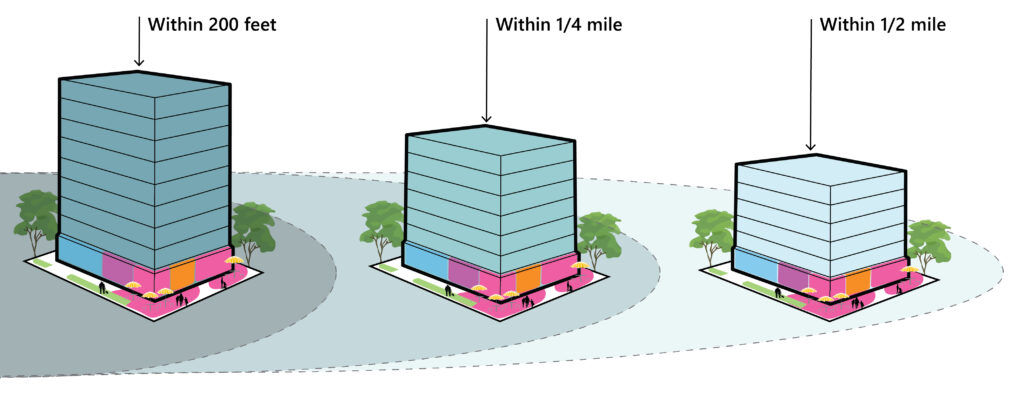
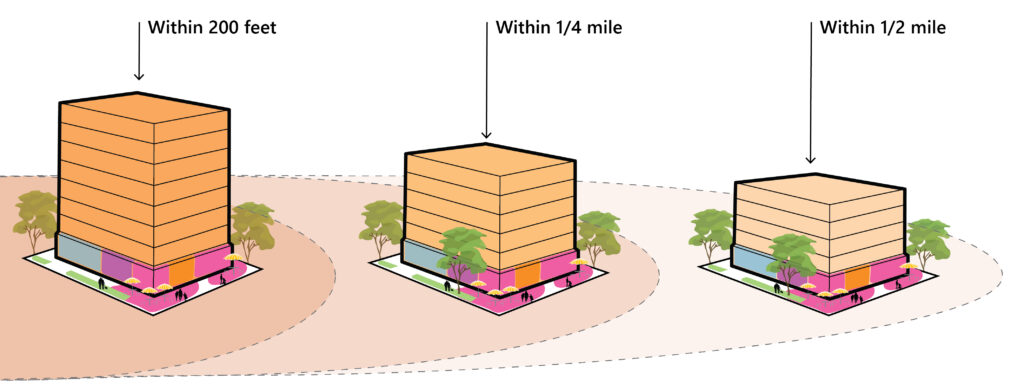
Applicable development standards for qualifying projects—including minimum density, height, and FAR standards—vary by tier and by distance from the stop. Tables and graphics summarizing the applicable standards for each tier are included below. Because SB 79’s default standards are likely to allow greater development capacity than existing standards in many jurisdictions, cities may need to decide whether to rely on the default framework or pursue a local ordinance or Transit-Oriented Development (TOD) Alternative Plan to provide more tailored local direction.
SB 79 TIER1 – DEVELOPMENT STANDARDS
|
|
|||
|---|---|---|---|
| Distance from TOD Stop | Within 200 feet | Within ¼ mile | Within ½ mile |
| Height | 95 ft | 75 ft | 65 ft |
| Density | 160 dwelling units/acre | 120 dwelling units/acre | 100 dwelling units/acre |
| Floor Area Ratio | 4.5 | 3.5 | 3.0 |
SB 79 TIER2 – DEVELOPMENT STANDARDS
|
|
|||
|---|---|---|---|
| Distance from TOD Stop | Within 200 feet | Within ¼ mile | Within ½ mile |
| Height | 85 ft | 65 ft | 55 ft |
| Density | 140 dwelling units/acre | 100 dwelling units/acre | 80 dwelling units/acre |
| Floor Area Ratio | 4.0 | 3.0 | 2.5 |
Steps Cities Are Taking Now
Cities are now working through what SB 79 implementation looks like in practice. For jurisdictions directly affected by the law, this work may already be underway through GIS screening, zoning analysis, ordinance development, or evaluation of a local TOD Alternative Plan.
- Understanding applicable TOD stops and zones. Jurisdictions are reviewing SB 79 tier maps, confirming which transit stops fall within local boundaries, and identifying the applicable quarter-mile and half-mile areas where SB 79 standards may apply.
- Assessing potential capacity implications. Once applicable TOD areas are confirmed, capacity analysis can help jurisdictions understand the potential residential development yield in applicable TOD areas. This information can inform local implementation decisions, potential ordinance updates, TOD Alternative Plan evaluation, and future planning efforts.
- Reviewing exclusions and phased applicability. SB 79 includes provisions that may exclude certain sites or phase in applicability based on site-specific or local conditions. Early review of which sites might not be subject to SB 79 can help identify where additional analysis or documentation may be needed.
- Determining whether a local implementation tool is appropriate. Some jurisdictions may choose to rely on SB 79’s default standards, while others may pursue a local ordinance or TOD Alternative Plan to better align implementation with local planning goals, transit geography, and capacity considerations.
- Coordinating with HCD and tracking updates. The California Department of Housing and Community Development’s (HCD’s) interpretation of SB 79 will continue to shape local implementation. Jurisdictions considering local ordinances or TOD Alternative Plans may benefit from early coordination, careful documentation, and continued tracking of technical assistance, advisory guidance, and proposed legislative updates as they evolve.
Resources
SB 79 implementation is actively evolving, and additional guidance, mapping updates, and regional materials may continue to be released. The following public resources can help jurisdictions track statewide guidance and regional mapping efforts.
STATEWIDE GUIDANCE
- HCD SB 79 Transit-Oriented Development webpage. The HCD SB 79 webpage provides statewide information on the law, HCD’s role in reviewing local ordinances and TOD Alternative Plans, and links to related submittal materials.
- SB 79 Advisory Clarifications on Definitions for Metropolitan Planning Organizations (March 20, 2026). HCD’s advisory clarifies key definitions and terms used in the Government Code to facilitate consistent implementation across jurisdictions.
- HCD SB 79 Local Enactment Submittal Form. Jurisdictions adopting a local SB 79 ordinance or TOD Alternative Plan must submit materials to HCD for review using HCD’s required submittal process.
REGIONAL MAPPING RESOURCES
SB 79 requires Metropolitan Planning Organizations (MPOs) to prepare tiered maps of TOD stops and zones in their regions. These maps are important starting points for understanding where SB 79 may apply locally. Some regional maps have been released in draft form, and updates may occur as MPOs finalize methodologies, incorporate feedback, or respond to changes in SB 79 implementation.
- MTC/ABAG Map – Bay Area region
- SACOG Map – Sacramento region
- SANDAG Map – San Diego region
- SCAG Map – Southern California region
Over time, maps may also need to be revisited as legislation changes, new transit stops or service patterns are added, or additional guidance is issued. Jurisdictions should confirm that they are using the most current publicly available version and should coordinate with HCD, MPO staff, and legal counsel as needed when evaluating local applicability.
Moving from Law to Practice
SB 79 implementation requires technical analysis, clear documentation to support local decision-making and HCD review, and practical tools for administration. Depending on local conditions and policy goals, jurisdictions may rely on the default standards established by state law, adopt a local ordinance, or pursue a TOD Alternative Plan. Ascent has been supporting jurisdictions through every stage of that process.
Our Urban Design + Planning Studio can assist with applicability screening, capacity analysis, updates to development and design standards, and technical documentation. We can also help make SB 79 easier for staff to administer with implementation tools such as checklists, FAQs, briefing materials, and parcel screening maps to support consistent administration. For jurisdictions pursuing a TOD Alternative Plan, we can help turn transit-oriented development into a strategy, aligning new land use patterns and urban form standards with the general plan, zoning framework, and community vision.
Have questions about what this means for your agency? Please reach out to the authors of this AscentShare or your preferred Ascent contact.